Army Reserve
Secret InvasionThe Army Reserve is one of the federal military forces mobilized against the Sligger crisis, marking the shift from scattered local searches to a coordinated campaign across multiple states. Its role is presented through deployment and field operations rather than through details of its internal structure: troops are sent to threatened locations, work alongside local authorities and civilian specialists, and remain in the field until the search is judged complete.
From proposed reinforcement to national deployment
The Army Reserve first enters the response as a possible reinforcement after three people are killed near Perdido Key State Park. The governor declares a state of emergency and hopes the president will send Army Reserve troops to help address the animal crisis. At this point, the request reflects the widening scale of the danger: the killings are no longer treated as an isolated local attack, but as grounds for seeking military assistance.
The federal response broadens further when the president declares a National State of Emergency because attacks have emerged in the Gulf states. A national news report announces that troops from both the Army Reserve and the National Guard have been deployed to various locations to contain and eliminate the creatures’ spread. The report connects the deployment to the Sliggers’ rapid reproduction and the risks they pose to public safety and the ecosystem. It also identifies the possibility of bio-terrorism as a cause under consideration, while presenting that possibility as unresolved rather than established.
This escalation follows earlier efforts to coordinate a coastal response. Governors in Virginia, New York, South Carolina, Georgia, and Florida had called in the National Guard, and the president had separately ordered the U.S. Coast Guard to become involved. Those measures show the crisis drawing in state and federal resources before the later national emergency explicitly places Army Reserve troops among the forces deployed. The Army Reserve’s appearance therefore belongs to a cumulative mobilization, not to a single response announced in isolation.
Deployment across threatened waterways
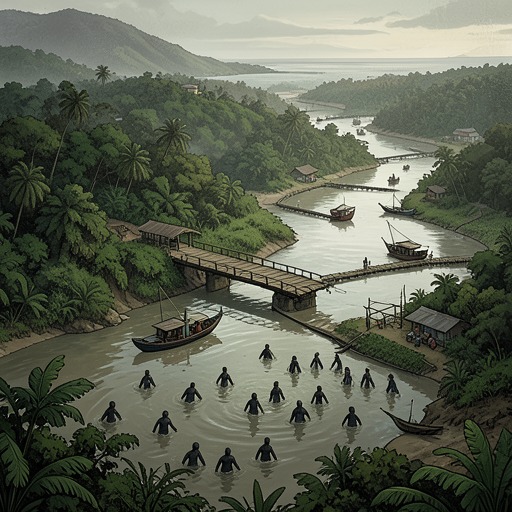
The Army Reserve’s operational footprint is described as geographically distributed. In Texas, troops are expected to arrive in Port Arthur, which the news report calls a possible origin point for the creatures’ current migration. There they are to assist local law enforcement in searching near waterways for Sliggers and their nests. The work is extensive by design: the search must cover the shorelines of the county’s lakes, inlets, and rivers, rather than focus on one suspected nest or one stretch of coast.
As the crisis spreads along the Gulf of Mexico, planners divide the wider campaign among three areas. One third of the troops are proposed for Port Arthur; another third are to continue westward from the forces already in Florida; the remaining third are to reach the Mississippi River immediately and follow the creatures’ trail upstream. The plan treats connected waterways as routes along which the animals may spread, and distributes personnel accordingly instead of concentrating the entire response at the latest reported attack.
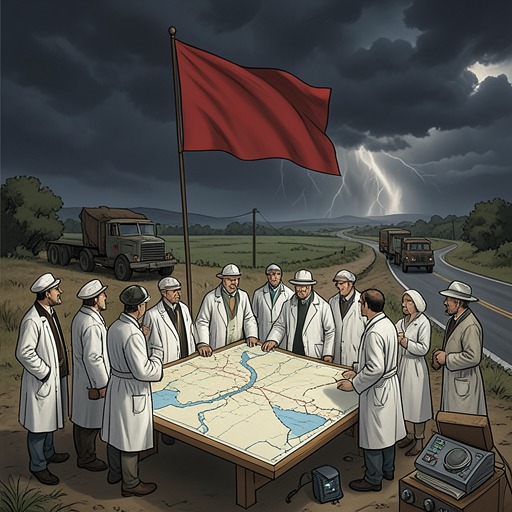
At a briefing for troops assigned to the Mississippi operation, the campaign’s route is laid out from New Orleans northward along the river, while two other infantry divisions are to work toward the same broader effort from Florida and Texas. The account identifies the Army Reserve as part of the deployed force, but does not specify that every formation in this briefing belongs to it. That distinction matters: the operation is presented as a coordinated military campaign involving multiple forces, not as an Army Reserve effort acting alone.
Search operations and cooperation
The Army Reserve’s clearest field action occurs after the creatures break into a hotel room in Baton Rouge. Four days later, sweeping Army Reserve troops locate and destroy a nest near the Mississippi River. They continue north, with Ron Tully’s team searching alongside them. The operation is not confined to a single strike: the joint search reaches St. Francisville, and the teams cover another forty miles of waterways beyond the Baton Rouge nest without finding another monster.
The military sweep depends on cooperation with people who have accumulated specific knowledge of the creatures. Ron’s team contributes expertise about their physical traits, rapid evolution, asexual reproduction, and the need to destroy them without leaving remains that could contaminate the ecosystem. In his assessment to the Department of the Interior, Ron reports that the creatures found in the campaign were exterminated cleanly and that the spread up the Mississippi had been eliminated. The text thus connects the Army Reserve’s search work to a broader objective than killing visible animals: the operation must also address nests and avoid leaving biologically dangerous remains.
Withdrawal and the end of the campaign
The Army Reserve remains part of the response through the final large-scale sweep. A month of work takes thousands of people hundreds of hours as they scour the waterways along the Sliggers’ paths. Once that search is finished, National Guard and Army Reserve troops return home. Local authorities continue searching as a precaution until they are satisfied the creatures are truly gone.
The withdrawal follows the president’s official declaration, a week earlier, that the Sligger crisis is over. It marks a transition from emergency deployment to local vigilance, not an assertion that the deaths and damage have been undone: life is only slowly returning to normal, and mourning and unanswered questions remain. Within that ending, the Army Reserve’s narrative function is concrete and limited but consequential. Its deployment supplies personnel for a geographically broad eradication effort, and its departure signals that the exceptional military campaign has ended even as the communities affected by the crisis continue to live with its aftermath.